
Retail Queue Management System
- #Analytics
- #Object Detection
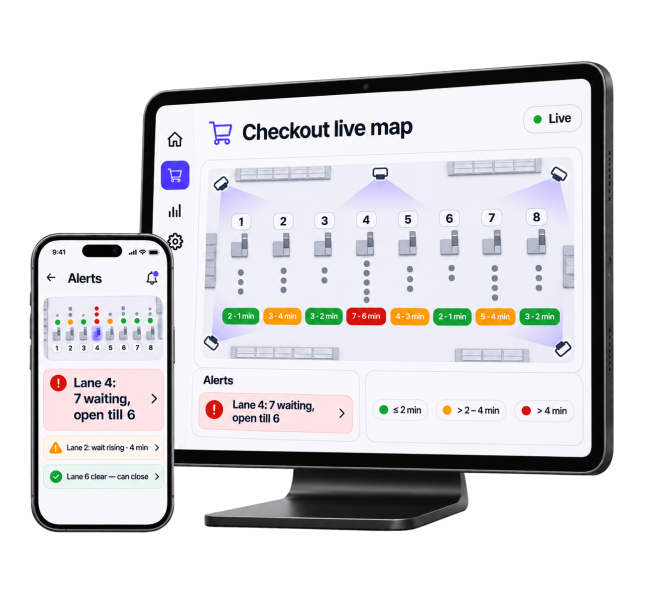
A queue management system for a regional grocery chain with 30+ stores. Five cameras track the checkout area, measure real wait times per shopper and alert floor managers when to open or close a lane.
- Computer Vision
- Data Analysis
Impact
The client is a regional grocery retailer with 30+ stores. Floor managers opened tills on judgment and nothing recorded wait times: our baseline found a 6.8-minute peak average, about 11 abandoned queues a day per store, and cashiers idle for 21% of a shift.
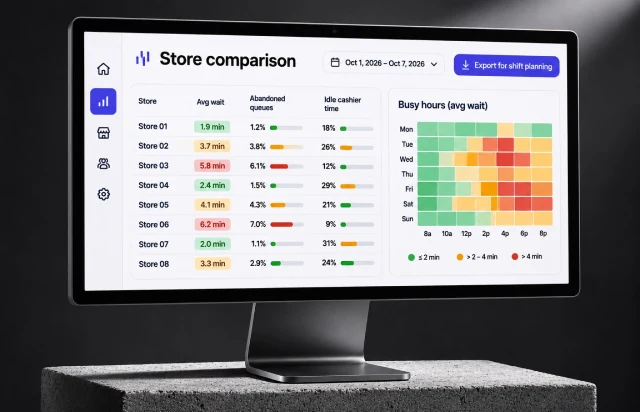
We built a system that follows each shopper across five cameras as one track, estimates and logs wait times per lane, and sends action alerts to managers' handhelds. It runs in 30+ stores, with HQ dashboards that feed shift planning alongside POS data.
Services we provided
Store Discovery and Baseline
Camera Planning and Calibration
Multi-Camera Tracking Models
Store and HQ Dashboards
POS and Workforce Integrations
Pilot, Rollout and Accuracy QA
Tech Stack

Python

Pytorch

Neural networks
Challenges and Solutions
🧐 Challenges
- Foot traffic comes in waves, managers see long queues only after they form, and opening a till takes four to six minutes.
- A queue starts in the aisles, so one camera over the tills could not follow a shopper to payment without double counting.
- Shift plans came from sales receipts, which miss every customer who gave up and left.
💡 Solutions
- Deep neural networks detect each shopper and follow them across all five cameras as one track, so nobody is counted twice.
- Position, direction and movement decide who is actually waiting, not just standing near a till.
- Wait time per lane is estimated every 5 seconds, and the real wait is logged for every shopper who reaches the till.
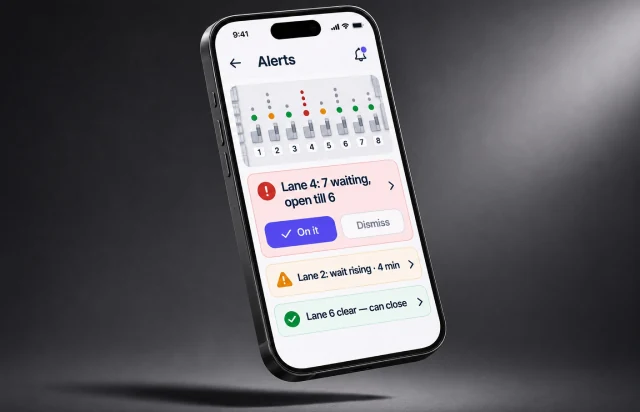
- When a line passes 6 people or a 4-minute wait, the floor manager gets an alert naming the lane and the action.
- Screens in 12 stores show the estimated wait per lane, with a QR code for the same view on a phone.
- Shoppers stay anonymous: no facial recognition, raw video deleted within 72 hours, and a GDPR impact assessment before the pilot.
Business value
- 40% shorter average checkout wait time, to about 4 minutes at peak.
- 57.66% less idle cashier time in the two-month pilot window.
- 5 fewer cart abandonments per store daily, roughly $400 in recovered daily sales.
- 82% of alerts get a response within three minutes.
- 96% count accuracy and 94% cross-camera re-identification.
User flow