
Hebrew Text-to-Speech
- #E-Learning
- #Voiceprocessing
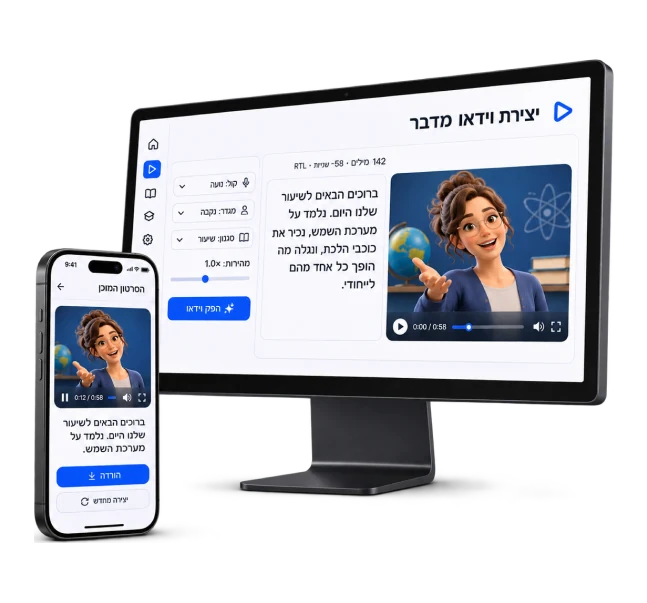
A Hebrew text-to-speech engine with AI lip-sync for an EdTech startup in Israel. Users paste ordinary Hebrew text, pick a voice and get a video of a photo or drawing speaking it in under a minute.
- Image Generation
- Natural Language Processing
Impact
The client is an EdTech startup in Israel that needed Hebrew speech for lessons, digital assistants and stories. Every voiceover went through a voice actor and a studio, at four to six days per script, and the best commercial Hebrew TTS tool tested misread 29% of a homograph-heavy sample.
We built a pipeline that adds vowels and stress from context, voices the text in four Hebrew voices and animates a single image from the same phoneme timeline. It runs on cloud GPUs and is available through a web studio and a REST speech API and SDK.
Services we provided
Hebrew Test Set and Native Evaluation
Voice Recording and TTS Model Training
Lip-Sync Model Adaptation
Web Studio Development
REST Speech API and SDK
QA and Load Testing
Tech Stack

Pytorch

Python

FastAPI
Challenges and Solutions
🧐 Challenges
- Hebrew is mostly written without vowels or stress marks, so the same letters can be two different words.
- Lip-sync models trained on English video barely know Hebrew sounds, and viewers notice a lip offset above 80 ms.
- Lessons, assistants and stories each need a different pace and tone from one pipeline.
- Studio voiceovers cost about $180 per finished minute and took four to six days per script.
💡 Solutions
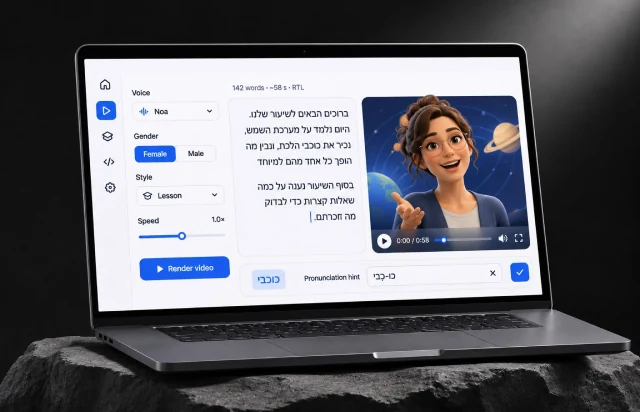
- A G2P model adds vowels and stress from sentence context, then StyleTTS2 voices the text.
- Four voices trained on 42 hours of studio recordings, each in lesson, assistant and story styles, with speed from 0.7x to 1.4x.
- Numbers, dates, addresses and English loanwords are read the way an Israeli would say them.
- Hebrew sounds are mapped to 14 viseme classes, and the lip-sync follows the TTS phoneme timeline to within 40 ms.
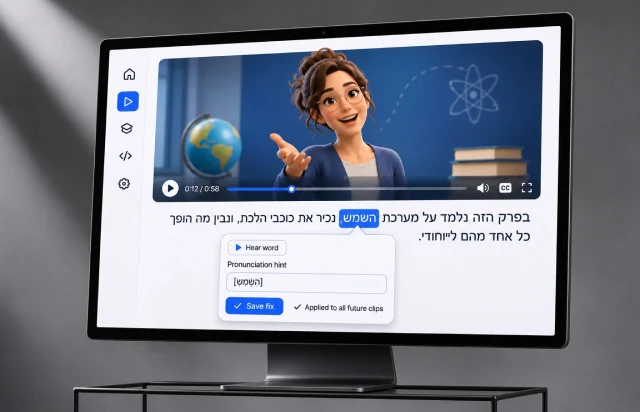
- Users flag a mispronounced word, add a hint, and the fix applies to every later clip.
- Export to MP3, WAV and MP4 with subtitles, from the web studio or the REST API.
Business value
- 95% of 2,400 test words pronounced correctly; 4.2/5 naturalness from the same native panel.
- <60 seconds from pasted text to video.
- Roughly $0.40 of GPU time per minute, vs. about $180 per finished minute of studio audio.
- 11,000 clips generated in the first quarter.
- Lips land within 40 ms of the sound.
- 4 Hebrew voices, 3 speaking styles.
User flow