
Drone Obstacle Avoidance System
- #Computer Vision
- #Object Detection
Obstacle-avoidance software for a robotics startup's indoor inspection drones. A DJI Mavic-class quadrotor sees shelving, cables and people through its stock RGB camera and steers around them on its own, with no GPS or LiDAR.
- Computer Vision
- Machine Learning
Impact
The client builds inspection drones for warehouses and industrial facilities. Every indoor flight was flown manually, about 14% of test flights ended in an abort, and LiDAR or stereo cameras were ruled out by a ~180 g payload limit and ~$1,200 per unit in added cost.
We built a perception and control stack that runs on an NVIDIA Jetson-class companion computer on the drone: a monocular depth model, an object detector and a planner that replans at 20 Hz. Around it sit a React ground control app for web and tablet, plus cloud replay and fleet reporting.
Services we provided
Computer Vision Model Training
Trajectory Planning and Flight Control
Simulation and Flight Testing
Ground Control Web and Tablet Apps
Cloud Analytics and Flight Replay
Fleet Operations and OTA Updates
QA and Field Validation
Tech Stack

Python

C++

Open CV

Pytorch

Tensorflow

Docker
Challenges and Solutions
🧐 Challenges
- A single 30 fps RGB camera gives no depth, and the estimate had to hold under flickering warehouse lights on a computer drawing under 15 watts.
- Forklifts, pallets and people change an aisle mid-flight, so the planner could not trust a map drawn that morning.
- Perception, flight control, the operator's screen and post-flight analytics ran on four unconnected machines.
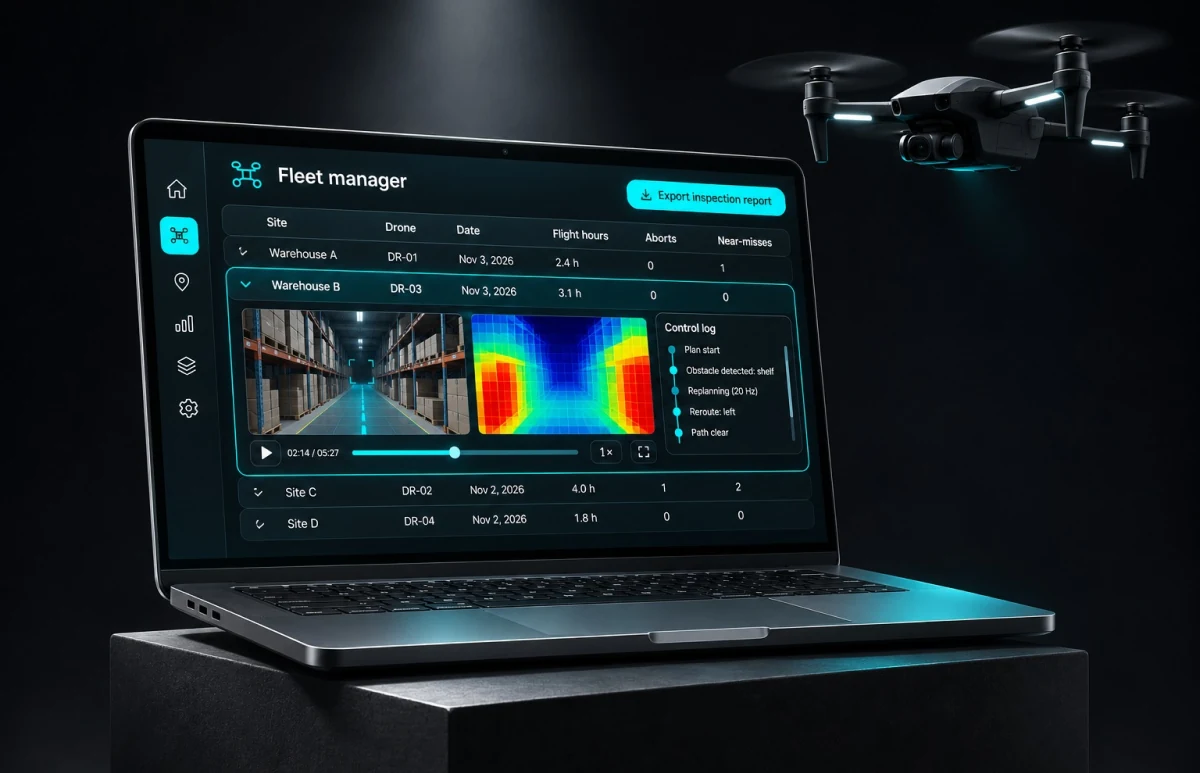
- Flight logs stopped at the DJI app: no replay and no near-miss count.
💡 Solutions
- Perception and planning run on the drone, since a cloud round trip over warehouse Wi-Fi would mean up to 80 cm of blind travel.
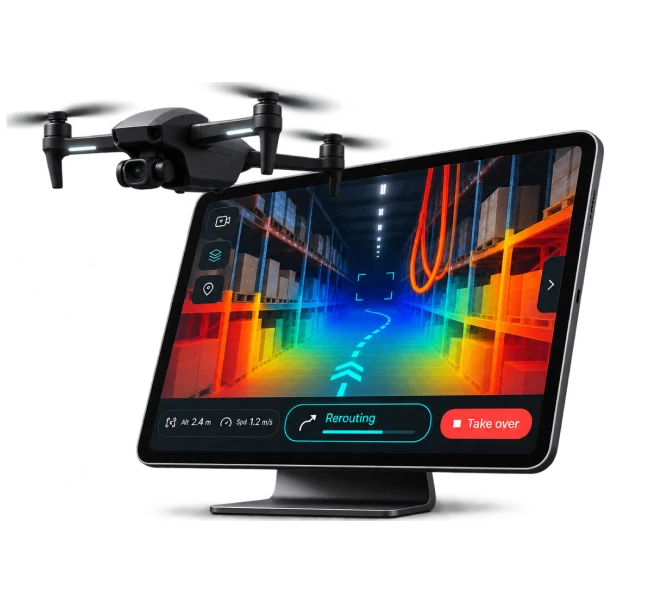
- A monocular depth model trained on about 18,000 labeled frames, plus an object detector for thin cables and glass, builds a 3D occupancy grid at 30 fps.
- A local planner replans at 20 Hz, keeps a 60 cm safety margin and falls back to hover-and-wait when the path is blocked.
- Velocity commands go out over MAVLink, or through the DJI SDK on Mavic-class airframes.
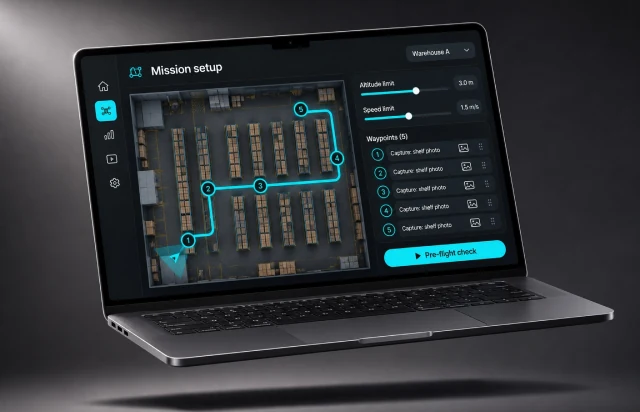
- A React web app and a tablet mode give operators route setup, a live depth overlay and one-tap takeover.
- Every flight uploads video, depth frames and the control log for replay, comparison across sites and inspection reports.
Business value
- 1,000+ hours of autonomous flight.
- < 60 ms end-to-end perception-to-control latency on embedded GPUs, with replanning at 20 Hz.
- 0 collisions across the last 300 autonomous test flights before pilot rollout.
- ~94% obstacle detection recall on the 120-scenario test suite.
- Autonomous indoor flight from a single RGB camera, with no depth sensor on board.
User flow