
3D Game Asset Pipeline
- #Computer Vision
- #Entertainment
A computer vision pipeline for an EU indie game studio that turns photos or video of real objects into photorealistic, game-ready 3D models with LODs and PBR textures, exported for Unreal, Unity, web, AR and VR.
- Computer Vision
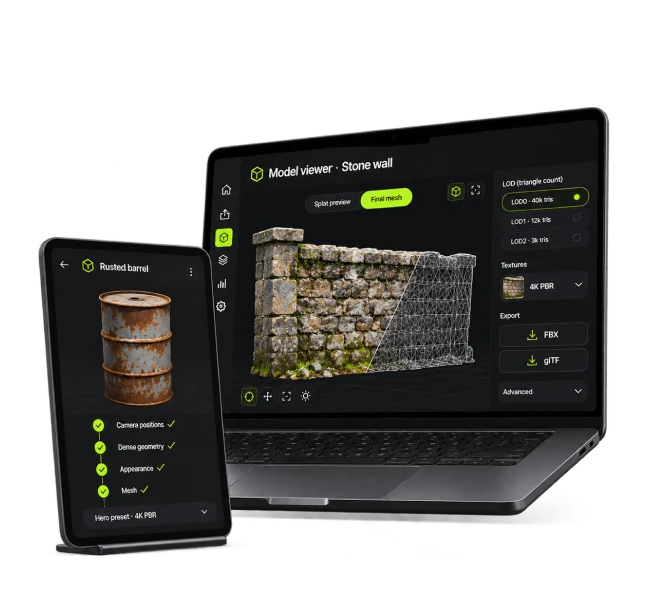
Impact
An indie game studio in the EU with 14 artists needed about 900 environment props for an open-world title. Modeling and texturing a mid-complexity prop by hand took about 14 hours, and the team shipped around 40 props a month.
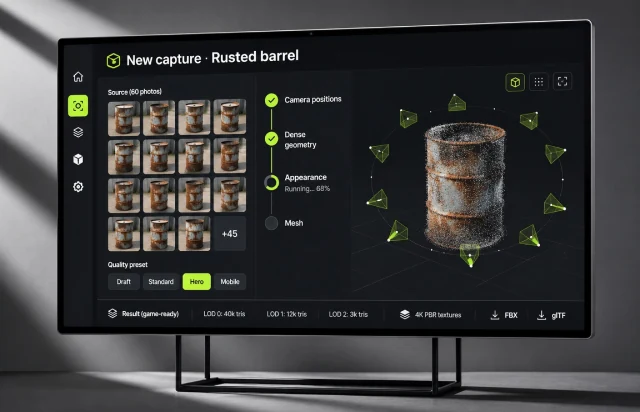
We built a computer vision pipeline that recovers camera poses with Structure from Motion, builds dense geometry with Multi-View Stereo, captures appearance with Gaussian Splatting and outputs a game-ready mesh. Artists run it from a web interface and export FBX and glTF for Unreal, Unity, web, AR and VR.
Services we provided
Computer Vision R&D
3D Reconstruction Pipeline
Mesh, LOD and PBR Texture Automation
Artist Web Interface and UX
In-Engine QA in Unreal and Unity
Mobile, AR and VR Export Presets
Tech Stack

Pytorch

Python
Challenges and Solutions
🧐 Challenges
- A mid-complexity prop took about 14 hours and $380 in artist time, and the game needed about 900 of them.
- Surfaces invented from reference images often came out too clean or too regular to look real.
- Raw scans run to two to four million polygons per prop, far too heavy for real time.
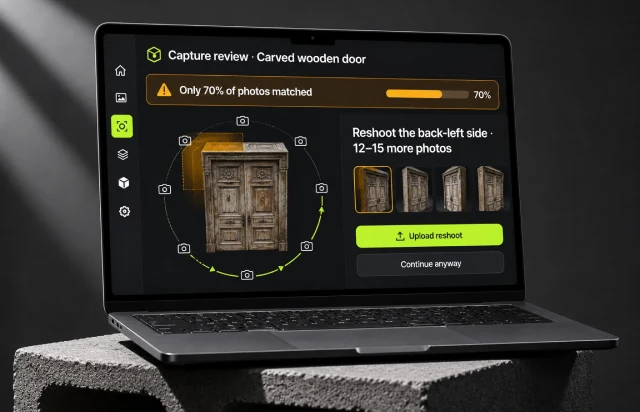
- Failed captures were discovered only after a full processing run.
💡 Solutions
- Structure from Motion matches features across 120 to 200 photos or a short video to recover each camera position, and flags captures under 85% image match for a reshoot before GPU time is spent.
- Multi-View Stereo estimates depth per pixel and fuses it into a dense point cloud of two to four million points.
- Gaussian Splatting reproduces the object's look from any angle in about 12 minutes on one GPU, against roughly 90 for the NeRF baseline; a NeRF-style pass fills thin or shiny parts.
- Poisson reconstruction or Marching Cubes builds a watertight mesh, reduced to three LODs of 40,000, 12,000 and 3,000 triangles with automatic UVs and 4K PBR textures.
- From video, the pipeline keeps sharp, well-spaced frames and drops blurry or near-duplicate ones.
- Exports as FBX and glTF, plus a 5,000-triangle mobile preset with ASTC and ETC2 texture compression.
Business value
- Up to 80% faster from capture to mesh.
- 14 hrs → 2.5 hrs artist time per prop.
- 640 game-ready assets in six months, over 100 a month at peak.
- 92% first-time capture success.
- 3 LODs and 4K PBR textures per asset.
- Failed jobs cut from about 1 in 4 to 1 in 12.
User flow