
Dance Learning App
- #E-Learning
- #Pose Detection
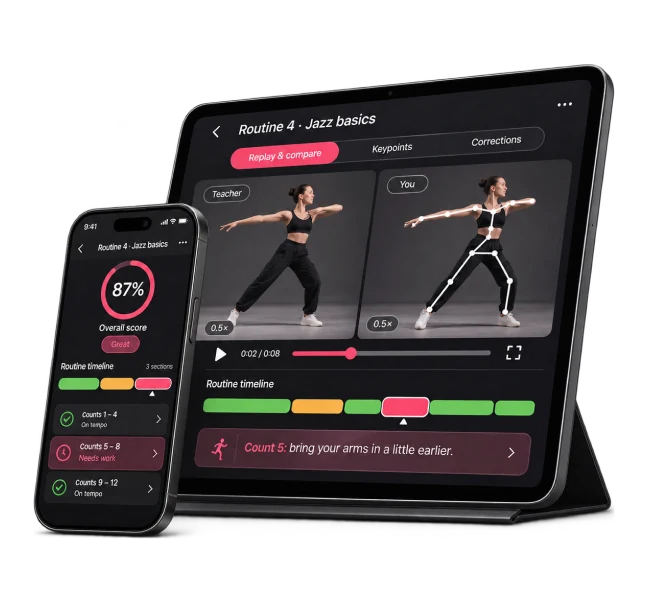
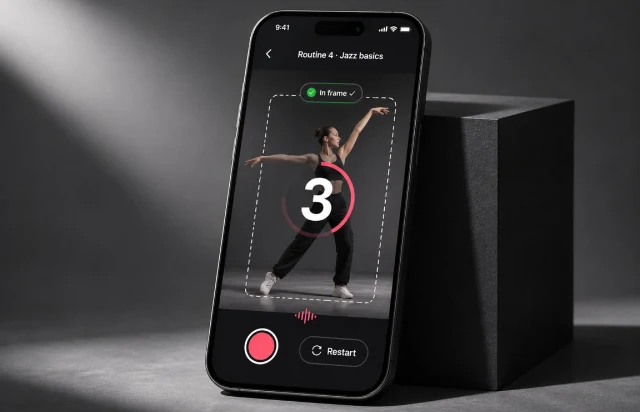
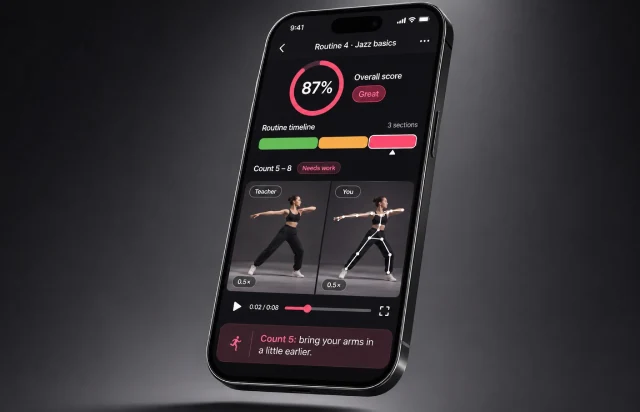
A dance learning app for a US EdTech company. A student records practice on a phone, and the app compares the movement with the teacher's reference and points to the exact count where timing or posture slipped.
- Computer Vision
Impact
The client runs online dance classes for teens and adults across the US. Students practiced alone and sent videos by direct message; each teacher got 40 to 60 a week, spent about 10 minutes on each and replied three or four days later.
We built an iOS and Android app with a pose analysis service behind it. It tracks 17 body keypoints from a single phone camera, aligns the student with the teacher by movement and returns up to three plain-language corrections, with a dashboard for teachers and studio admins.
Services we provided
Discovery and Pose Model PoC
UX/UI Design
Mobile App Development
Pose Analysis Service
Teacher Dashboard and Content Library
QA, Device Testing and Beta
Tech Stack

Python

Tensorflow
Challenges and Solutions
🧐 Challenges
- Home practice happens in cluttered, low-light rooms with a phone at odd angles, and the model still had to catch a 15° elbow drop.
- Students start late, slow down and face the screen mirrored, so a frame-by-frame comparison would flag everything.
- Routines carry music, counts, sections, style and level, and scores had to stay comparable across attempts and weeks.
💡 Solutions
- A TensorFlow pose model extracts 17 body keypoints per frame at 30 fps, normalized for height and distance from the camera.
- Dynamic time warping aligns student and teacher by movement, and mirror mode flips the reference automatically.
- Timing gaps above 120 ms are flagged with the count number.
- Posture is checked across 12 joint angles; a gap over 15° that holds for several frames counts as a real issue.
- After each attempt the dancer gets at most three corrections, ranked by impact.
- A teacher dashboard with role-based access and a content library organized by style, level, section and count.
Business value
- 87% agreement between system flags and teacher-marked corrections.
- ~2 minutes per flagged clip, about 80% less review time.
- Corrections ~35 seconds after each attempt, at home.
- Average attempts to reach a pass score down from 9 to 5.
- 6 dance styles at public launch.
User flow