
Emotion-Aware VR Tutor
- #E-Learning
- #Education
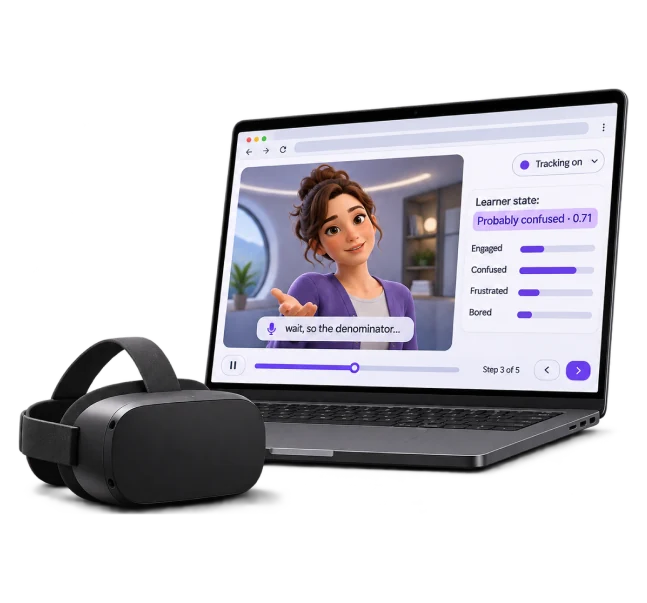
Custom emotion recognition for a US EdTech company's 3D avatar tutor. It reads face, voice and headset motion together to spot four learner states, so the avatar slows down, rephrases or skips ahead, in Chrome and on WebXR headsets.
- Computer Vision
- Machine Learning
Impact
The client runs a conversational tutoring product for adult learners, with about 11,000 lessons a month, a third of them on VR headsets. Its 3D tutor reacted only to keywords: 38% of learners said it kept going when they were lost, and lesson completion sat at 68%.
We built our own multimodal model stack on the client's consented session data: face, voice and headset-motion models joined by a fusion layer that drives 26 avatar micro-gestures. It runs in Chrome and on standalone WebXR headsets, with a dashboard for the learning team.
Services we provided
Discovery and Data Audit
Data Labeling and Model Training
Multimodal Fusion Engine
3D Avatar Animation with Three.js
Consent Flow and Data Privacy
Bias Audit and QA
Launch and Model Retraining
Tech Stack

Pytorch

Tensorflow

Open CV

FastAPI
Challenges and Solutions
🧐 Challenges
- Commercial emotion tools reached 58% agreement with human labels on real sessions, and 44% when a headset covered the upper face.
- 57% of sample clips were shot in low light and 31% had a headset blocking the eyes, so the face alone could not carry the signal.
- The first prototype took 1.1 seconds from camera frame to reaction, against a 300 ms budget on laptops and standalone headsets.
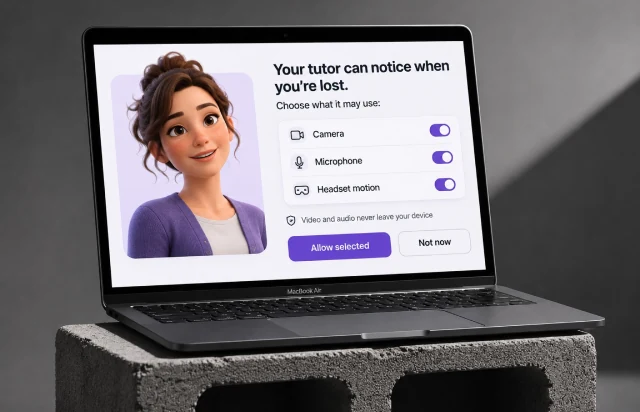
- Camera and microphone data needed consent, control over where data lives, a one-tap off switch and proof the models work across ages, skin tones and accents.
💡 Solutions
- Separate face, voice and body models trained on 210,000 labeled frames and 14,000 voice clips from consented sessions.
- Facial landmarks and action units feed a lightweight CNN that runs at 15 fps in the browser.
- Voice prosody is compared with each learner's own baseline, so confusion is caught even with the camera off.
- A confidence-weighted fusion layer with a three-second window shifts weight to voice and posture when the headset hides the face.
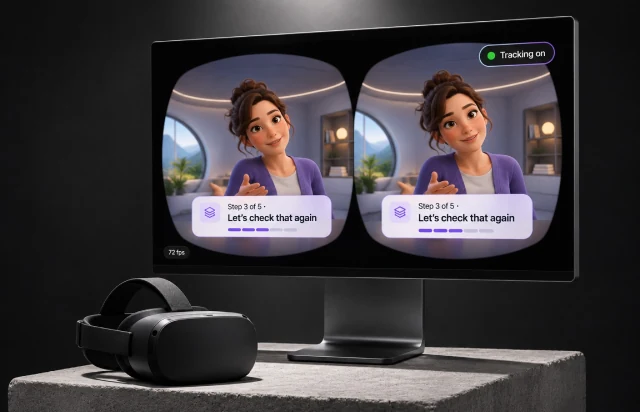
- The avatar answers with 26 short micro-gestures and adjusts its wording and pace, rendered with Three.js for the browser and WebXR.
- Raw frames and audio never leave the device; only per-window scores reach the server, and they are deleted after 90 days.
Business value
- 81% macro-F1 across four learner states.
- 77% recall on confusion in low light, up from 41%.
- 280 ms from frame to reaction at p95, on a laptop or a standalone headset.
- 72 fps held on a standalone headset.
- 23 lesson segments reworked in the first quarter based on the dashboard.
- 86% opt-in on the 54-word consent screen.
User flow