
AI Content Detection Software
- #SaaS
- #Text Detection
AI text detection for a global content platform with UGC communities, enterprise publishing and a university LMS. It scores each submission sentence by sentence in nine languages and gives moderators a short reason.
- Machine Learning
- Natural Language Processing
Impact
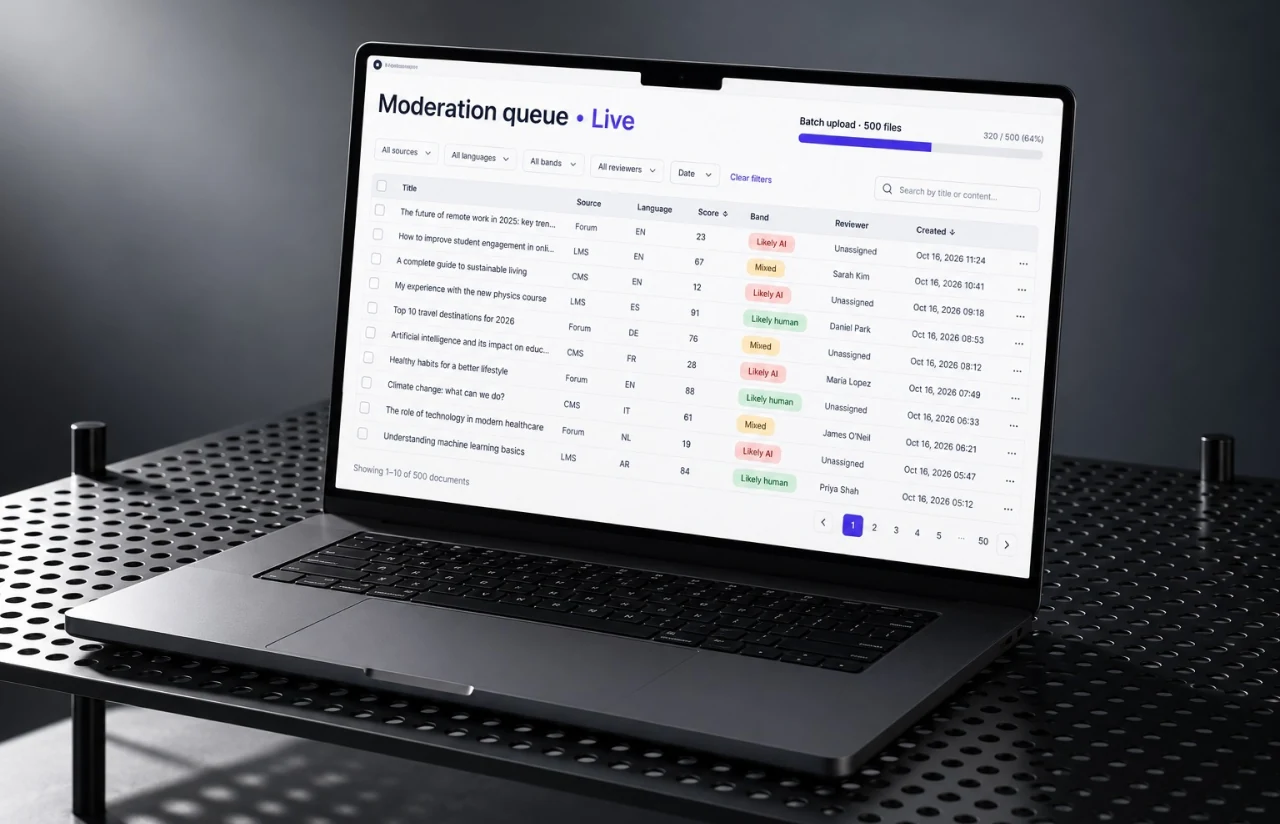
The client runs a platform that hosts user-generated content communities, publishes editorial material for enterprise customers and operates an LMS used by universities. It received about 1.4 million submissions a week, and around 40 moderators were pasting suspect items into free AI checkers, 9 to 11 minutes each, with scores nobody could explain.
We built an AI content detector inside the client's own workflow. It combines statistical NLP features with a fine-tuned transformer into one versioned 0 to 100 score, and runs through a REST API, a streaming API and CMS and LMS plugins.
Services we provided
Training Corpus Building
Statistical NLP Feature Engineering
Transformer Classifier Fine-Tuning
Scoring and Calibration Engine
API, CMS and LMS Integrations
UI/UX Design
QA, Monitoring and Retraining
Tech Stack

Python

Pytorch

Huggingface

PostgreSQL

Docker

AWS
Challenges and Solutions
🧐 Challenges
- Free detectors flagged formal writing, especially by non-native speakers, about 9% of the time and failed on short posts and AI-paraphrased text.
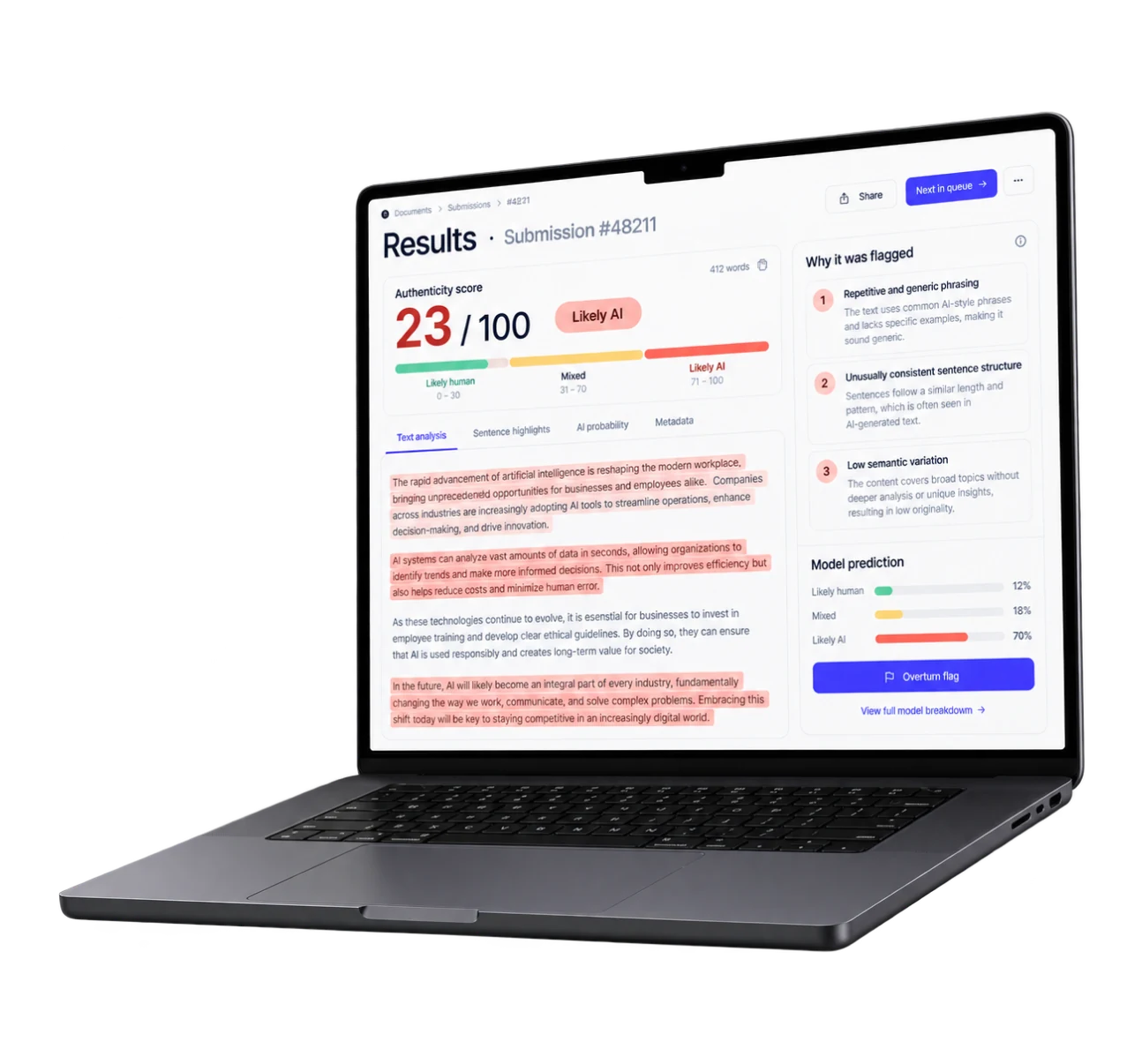
- A bare percentage was not a decision: moderators needed sentence highlights, a confidence band and a way to disagree inside their existing queue.
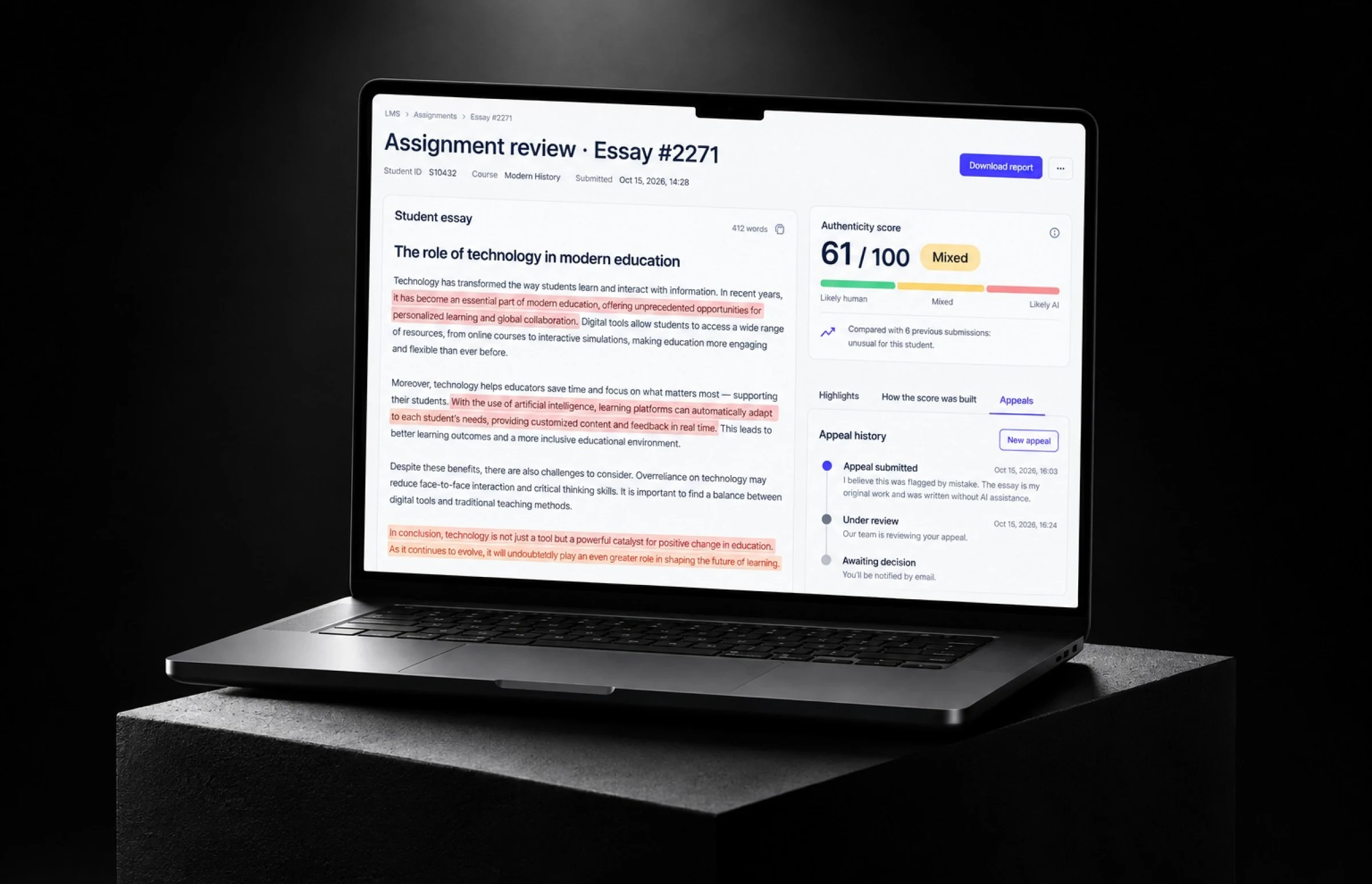
- A university treats a flag as an integrity issue and a publisher as an editorial question, so one threshold and appeals flow could not fit both.
💡 Solutions
- A statistical layer computes about 60 language features per document, such as perplexity and burstiness, in around 40 ms without a GPU.
- A transformer fine-tuned on about 4.2 million documents in nine languages returns a probability for every sentence.
- A calibration layer merges both signals into a versioned 0 to 100 score with three bands: likely human, mixed and likely AI.
- Texts under about 120 words get a "too short to score" state instead of a guess.
- One-click overturns with a reason feed a weekly retraining job.
- Per-tenant retention, encryption keys and region, plus an audit trail on every score.
Business value
- ~96% detection accuracy on client data.
- ~1.2% false positives on human writing, down from ~9%.
- <800 ms per document at p95.
- ~14 hrs/week saved per moderator.
- Median approval of enterprise articles cut from 19 hours to 40 minutes.
- Both at-risk universities renewed, and four more institutions signed within two quarters.
User flow